The source disappears
People remember a conclusion but lose what the original evidence actually said.
 SMOOTH FLOWCONSULTANCY
Governed organisational context · Currently in R&D
Organisations do not just lose information. They lose context. Smooth Flow OS is being designed to preserve how sources, human understanding, AI inference, decisions and change connect over time.
Product vision, not a claim of deployed software.
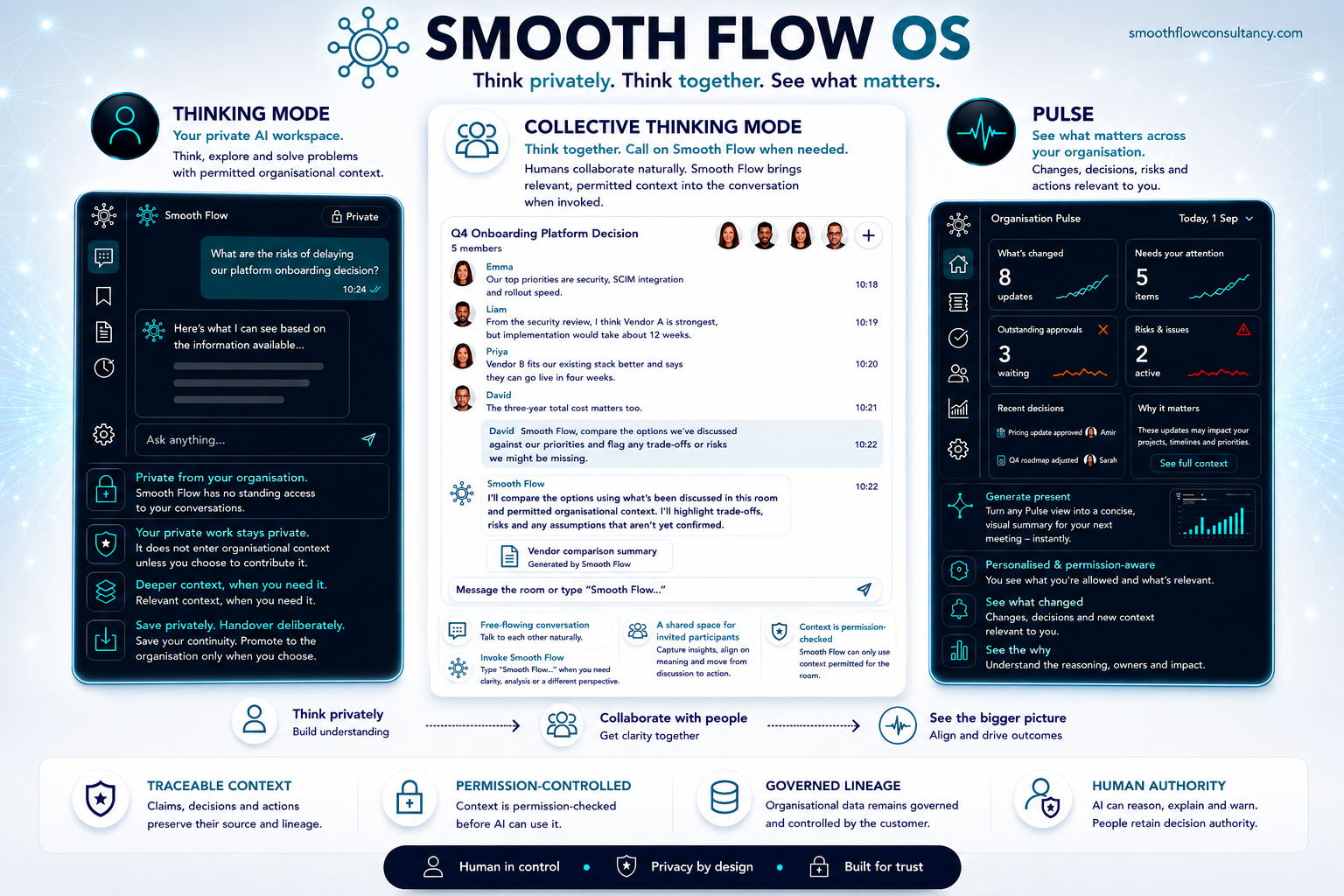
PRIVATE THOUGHTHUMAN COLLABORATIONRELEVANT CONTEXTProduct vision / experience preview
This visual explores how the three experiences could feel together. It is a design reference—not a screenshot of production software.
The distance we are reducing
People remember a conclusion but lose what the original evidence actually said.
What a person understood—or what AI inferred—can become detached from its status and uncertainty.
Authority, alternatives, approvals and why something changed are difficult to recover later.
Corrections and new understanding replace the past instead of preserving what was known at the time.
The AI is not the product
Identity and deterministic permissions set the maximum context a person—and therefore the model—may use.
Private reasoning does not become organisational property merely because Smooth Flow helped someone think.
Evidence, claims, human interpretation, AI inference, decisions and unresolved questions keep their status.
Humans decide what to contribute, what the organisation will act upon and what needs approval.
Smooth Flow’s proposition is the governed context around AI-assisted work—not a claim of uniquely intelligent AI.
This is the intended product and architecture direction. Smooth Flow OS remains in R&D; these controls are not being presented as production-validated.
One connected system
The first product loop connects private work to organisational context through a deliberate human boundary.
Three parallel experiences
Each experience has a clear boundary. AI can assist within it, but people remain responsible for what is shared, decided and done.
Private work with permitted organisational context.
Your organisation cannot access your Thinking Mode. Smooth Flow has no standing access to your private conversations.
People collaborate with people.
Smooth Flow does not silently participate. A human deliberately invokes it—such as with @Smooth Flow—when context, contradiction or analysis would help.
A permission-bound organisational awareness surface.
Pulse is being designed to surface relevant changes, decisions, risks, actions, approvals, contradictions and unresolved issues.
The architecture beneath the promise
Smooth Flow is being specified so deterministic software and authorised humans govern context and state transitions—not the language model.
Identity → deterministic permissions → permitted context → LLM reasoning. The model never receives the whole database and then decides what to hide. Relevance may narrow what is surfaced; it cannot expand access.
Evidence, claims, human-understood meaning, interpretation, assumptions, AI inference, decisions and outcomes keep distinct status. Competing interpretations may coexist.
Source → claim → what someone understood → AI inference → decision → action → outcome. Contributors, authority, uncertainty, disagreement, correction and supersession remain attached.
A document does not become organisational truth when contributed. The original remains intact while claims, interpretations, assumptions and uncertainty around it can be represented separately.
Smooth Flow must not represent greater temporal precision or certainty than a source supports. Approximate stays approximate; unknown stays unknown; genuinely unknowable stays unknowable.
Permission to see, permission to contribute, decision authority and approval authority remain different. Seeing does not grant the right to change; contributing does not make something true or grant authority to decide.
Model output cannot alter permissions, security boundaries, authority, application code or governance rules. It may propose; deterministic logic and authorised humans govern transitions.
The human layer around the OS
The consultancy understands intended versus lived reality. Smooth Flow OS is being designed to preserve and connect organisational context as that reality evolves.
Explore a challenge with us →Understand intended processes, lived work, responsibilities, authority and information flows.
Configure Smooth Flow around actual roles, permissions, workflows, contribution paths and decision practices.
Help people understand private work, deliberate Handover, Collective Thinking and responsible use of context.
Help governance and organisational understanding evolve as the organisation itself changes.
Early Access validation programme
This is not a finished-product waitlist. Smooth Flow OS remains in R&D. Early Access exists to test assumptions, boundaries, workflows and governance against how organisations really operate.
Tester feedback becomes evidence. It does not automatically become the roadmap, and displayed concepts are not claims of implemented capability.